E-commerce (electronic commerce) is the activity of electronically buying or selling of products on online services or over the Internet. The term was coined and first employed by Dr. Robert Jacobson, Principal Consultant to the California State Assembly’s Utilities & Commerce Committee, in the title and text of California’s Electronic Commerce Act, carried by the late Commmittee Chairwoman Gwen Moore (D-L.A.) and enacted in 1984. E
Electronic commerce draws on technologies such as mobile commerce, electronic funds transfer, supply chain management, Internet marketing, online transaction processing, electronic data interchange (EDI), inventory management systems, and automated data collectionsystems. E-commerce is in turn driven by the technological advances of the semiconductor industry, and is the largest sector of the electronics industry.
Modern electronic commerce typically uses the World Wide Web for at least one part of the transaction’s life cycle although it may also use other technologies such as e-mail. Typical e-commerce transactions include the purchase of online books (such as Amazon) and music purchases (music download in the form of digital distribution such as iTunes Store), and to a less extent, customized/personalized online liquor storeinventory services.[1] There are three areas of e-commerce: online retailing, electronic markets, and online auctions. E-commerce is supported by electronic business.[2]
E-commerce businesses may also employ some or all of the followings:
- Online shopping for retail sales direct to consumers via Web sites and mobile apps, and conversational commerce via live chat, chatbots, and voice assistants;[3]
- Providing or participating in online marketplaces, which process third-party business-to-consumer (B2C) or consumer-to-consumer (C2C) sales;
- Business-to-business (B2B) buying and selling;[4]
- Gathering and using demographic data through web contacts and social media;
- Business-to-business (B2B) electronic data interchange;
- Marketing to prospective and established customers by e-mail or fax (for example, with newsletters);
- Engaging in pretail for launching new products and services;
- Online financial exchanges for currency exchanges or trading purposes.
Types of e-commerce
If you’re starting an ecommerce business, odds are you’ll fall into at least one of these four general categories.
Each has its benefits and challenges, and many companies operate in several of these categories simultaneously.
Knowing what bucket your big idea fits in will help you think creatively about what your opportunities and threats might be.
1. B2C – Business to consumer.
B2C businesses sell to their end-user. The B2C model is the most common business model, so there are many unique approaches under this umbrella.
Anything you buy in an online store as a consumer — think wardrobe, household supplies, entertainment — is done as part of a B2C transaction.
2. B2B – Business to business.
In a B2B business model, a business sells its product or service to another business. Sometimes the buyer is the end user, but often the buyer resells to the consumer.
B2B transactions generally have a longer sales cycle, but higher order value and more recurring purchases.
Recent B2B innovators have made a place for themselves by replacing catalogs and order sheets with ecommerce storefronts and improved targeting in niche markets.
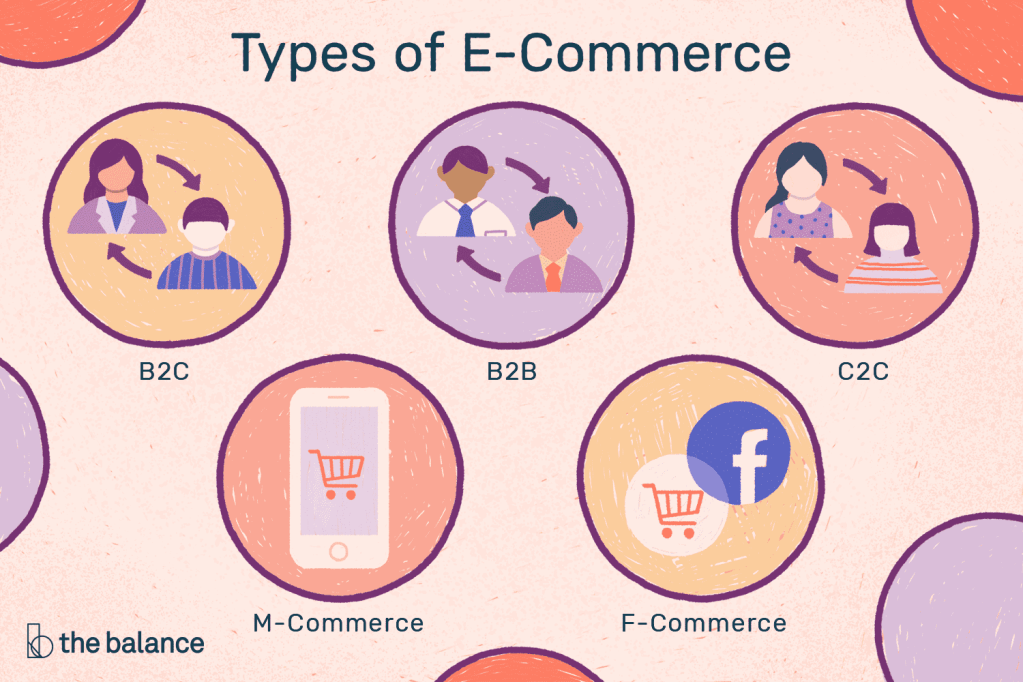
3. C2B – Consumer to business.
C2B businesses allow individuals to sell goods and services to companies.
In this ecommerce model, a site might allow customers to post the work they want to be completed and have businesses bid for the opportunity. Affiliate marketing services would also be considered C2B.
4. C2C – Consumer to consumer.
A C2C business — also called an online marketplace — connects consumers to exchange goods and services and typically make their money by charging transaction or listing fees.
Online businesses like Craigslist and eBay pioneered this model in the early days of the internet.
C2C businesses benefit from self-propelled growth by motivated buyers and sellers, but face a key challenge in quality control and technology maintenance.
 educationhub